
BINGE EATING | RESTRICT-BINGE CYCLES | RECOVERY
Why Dieting Leads to Binge Eating
And What to Do Instead
A psychologist's guide to the restrict-binge cycle, the science behind it, and how to find a gentler way forward

If dieting is meant to help, why does it so often make things worse?
There is a question many people carry quietly (sometimes for years) and rarely feel safe enough to ask out loud.
“I have tried every diet. I know what I should be doing. So why do I keep ending up back here?”
If this sounds familiar, you are not alone. And more importantly, there is a very clear reason this keeps happening.
You may have noticed the pattern yourself. You decide to take control. You eat less, avoid certain foods, draw clearer lines. And for a while, it feels like it is working.
Until it does not.
The urges build. Thoughts about food become louder and harder to ignore. Something eventually gives. And in the aftermath, the familiar weight of guilt, frustration, and a quiet resolve to try harder tomorrow.
What I want to offer you here is a different understanding of what is actually happening in that cycle. Because binge eating is not a failure of dieting. In many cases, it is a direct and predictable result of it.
You are not lacking discipline.
You are caught in a cycle that dieting itself helps to maintain.
Understanding that cycle is often the first step toward something different.
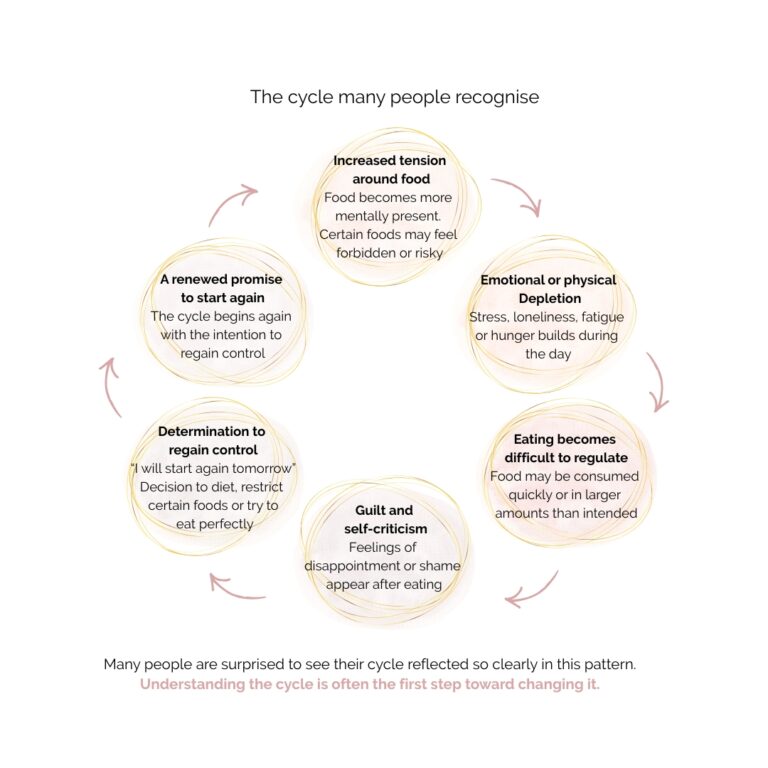
The restrict-binge cycle explained
It tends to move through these stages:
- Restriction begins: physically (eating less, skipping meals) or mentally (labelling foods as off-limits)
- Physical hunger and psychological deprivation begin to build
- Food becomes more mentally present, more appealing, more urgent, harder to ignore
- Eating begins, often with a sense of urgency or loss of control
- It becomes difficult to stop, even when you want to
- Guilt, shame, and self-criticism follow
- A renewed resolve to restrict, and the cycle begins again
What makes this cycle so difficult to escape is that the very solution people reach for (more control, more restriction) is the same thing that fuels the problem.
Why restriction triggers binge eating
It is important to understand that restriction does not only mean eating very little. It can also be entirely internal, a pattern of thought and meaning around food that creates the same physiological and psychological response, even when enough food is technically present.
Restriction can look like:
- Telling yourself certain foods are “bad” or off-limits
- Delaying meals or waiting until you have “earned” eating
- Eating less than your body needs because you feel you should
- Planning to compensate later for something you have already eaten
- “Being good” all day with the intention of controlling the evening
- Feeling guilt or anxiety after eating foods that are not on your approved list
Your body does not distinguish between physical restriction and psychological restriction. What it registers is simply: “Food is not reliably available.” And it responds accordingly with increasing urgency, increasing preoccupation, and a powerful biological drive to eat.
Restriction is not just about calories.
A mind that has declared certain foods forbidden is a mind already in a state of scarcity.
And scarcity creates urgency.
The biology behind the cycle
When the body experiences restriction — whether physical or psychological — it activates a set of biological responses that are specifically designed to restore energy and protect survival. These are not signs of weakness. They are signs of a body doing exactly what it was built to do.
In a state of perceived restriction:
- Ghrelin, the hunger hormone rises, increasing the drive to eat
- Leptin, which signals fullness — becomes less effective
- The reward value of food increases, making it feel more compelling
- The brain directs more attention toward food-related cues, smells, images, thoughts
- The prefrontal cortex, responsible for impulse regulation, has reduced influence
This is the physiological reality of what happens when restriction is present. The body becomes biologically primed to seek out food. And the harder you try to resist that drive through willpower alone, the more depleted and overwhelmed that system becomes.
This is not a personal failing. It is a well-designed survival system responding to a perceived threat.
The psychological layer: scarcity thinking
When foods are mentally placed off-limits, or when there is a sense that eating must be controlled or earned, a particular kind of thinking can take hold.
It often sounds like:
- “I should not be having this”
- “This is my last chance before I start again tomorrow”
- “I have already ruined it, so it does not matter now”
- “I will be good from Monday”
- “I just need to get this out of my system”
These thoughts create a sense of urgency and finality around food, a now-or-never quality that makes it almost impossible to eat in a calm or measured way.
Psychologists sometimes refer to this as the ‘abstinence violation effect’. When a rule has been broken (even a self-imposed one), the mind can shift into a mode of all-or-nothing thinking. If the diet is already ruined, there is a sense that you may as well continue. The damage is done.
This is not irrational. It is a completely understandable response to a rigid framework that was never designed to accommodate being human.
All-or-nothing thinking is one of the most powerful maintaining factors in the restrict-binge cycle.
It turns a moment of eating into evidence of failure.
And failure, in this context, tends to invite more eating — not less.
The role of emotions in the cycle
For many people, the restrict-binge cycle is not purely about food. Emotions play a significant and often underestimated role.
Restriction often begins not from a neutral place, but from one of discomfort, such as body dissatisfaction, anxiety, a sense of being out of control in other areas of life. Dieting can feel like a way of addressing that discomfort. A sense of structure, when other things feel uncertain.
And then, when the restriction builds and something gives, food can serve another emotional function: relief, numbing, comfort, escape. The binge is not just about hunger. It is often about depletion of a different kind.
This emotional dimension is one of the reasons that purely food-focused approaches such as meal plans, calorie targets or eating guidelines often do not resolve the cycle on their own. The pattern has roots that go deeper than eating behaviour.
Understanding the function that both the restriction and the binge are serving, as is, what they are each doing for you, is often one of the most illuminating parts of recovery work.
How shame keeps the cycle going
There is one more element of this cycle that deserves careful attention: shame.
After a binge, shame is almost always present. It can be loud and immediate, a rush of self-criticism, disgust, disappointment. Or it can be quieter and more chronic, a background sense of being someone who cannot get this right.
And shame, despite how it feels, does not motivate change. Research consistently shows that shame activates the threat response in the nervous system, the same system that drives the urge to binge in the first place. Shame does not create safety. And without safety, the cycle continues.
This is why approaches to recovery that centre on compassion, rather than criticism, tend to be more effective. Not because they are soft or permissive, but because they work with the nervous system rather than against it.
Shame is not a solution to binge eating.
It is one of its most reliable fuels.
Recovery becomes possible when understanding replaces self-blame.
What actually helps: breaking the cycle
Breaking the restrict-binge cycle is not about finding a better diet, or developing more self-discipline. It is about reducing the conditions that make the cycle necessary in the first place.
This is a gradual process and it rarely looks like a straight line. But there are consistent patterns that tend to support change.
1. Regular, sufficient eating
One of the most important and often most counterintuitive steps is to eat more consistently, not less. This means not skipping meals, not waiting until hunger becomes urgent, and allowing enough food to genuinely nourish the body.
When the body begins to trust that food is reliably available, the biological drive toward urgency and overconsumption begins to settle. This does not happen overnight. But it is one of the most foundational shifts in recovery.
2. Moving away from food rules
Rigid rules around food, whether formal (a diet plan) or informal (a personal set of allowed and forbidden foods), tend to sustain the psychological restriction that feeds the cycle.
Gradually softening these rules and not abandoning structure entirely, but questioning which rules are actually serving you and which are simply maintaining the pattern, can reduce the sense of scarcity that drives urgency.
3. Working with all-or-nothing thinking
The cognitive shift from all-or-nothing thinking toward a more flexible, compassionate inner framework is one of the most important aspects of recovery. This often involves noticing the moments when black-and-white thinking appears: “I have ruined it now,” “I might as well carry on”, and developing a different response.
This is not about positive thinking. It is about building genuine psychological flexibility around food and eating.
4. Understanding the function of the cycle
Perhaps the most important shift of all is moving from trying to stop the behaviour, to genuinely understanding what it is doing. What function does the restriction serve? What does the binge provide? What emotions are present before, during, and after?
When the function of a behaviour is understood — truly understood, not just intellectually recognised — something changes in how it is experienced. It becomes less automatic. Less inevitable. And more open to a different response.
What if binge eating is not the problem to be solved?
What if it is a response to restriction, to depletion, to emotions that have not yet found another way through?
When we begin to ask that question with genuine curiosity, something different becomes possible.
Frequently Asked Questions
Dieting creates both physical and psychological restriction. This triggers biological responses, increased hunger hormones, heightened food reward, reduced impulse regulation, alongside psychological patterns like scarcity thinking and all-or-nothing mindset. The result is a predictable drive toward overeating, not a failure of willpower.
No. Binge eating is most accurately understood as a biological and psychological response to deprivation, physical or psychological. Willpower operates at its lowest when the body is depleted, hungry, and under stress. Relying on it at those moments is not a realistic strategy.
Some people do make meaningful progress through self-directed change, particularly around eating patterns and food rules. For many, however, the emotional and psychological layers of the cycle benefit from working with a specialist. Understanding the function of the pattern, and developing new ways of responding, is often where the deeper change takes place.
There is no single answer. For some, noticeable shifts happen within weeks of changing eating patterns. For others, particularly where the cycle has been present for many years or where emotional eating is a significant driver, meaningful change may take longer. What tends to matter most is consistency, self-compassion, and appropriate support, not speed.


Seeking further support? Access our live webinars specifically addressing the restrict-binge cycle, emotional eating, and recovery.
Ready to break the cycle?
If you recognise yourself in this blog, working with a specialist can help you understand what is driving the pattern and begin to build a genuinely different relationship with food. Book a free 15-minute consultation to explore what support might look like for you.
theeatingdisorderpsychologist.com